Showing posts with label probes. Show all posts

Thursday, April 27, 2006

Here. There. Everywhere! (Part 5)

So far in my installments of "Here. There. Everywhere." I've discussed missions to Mercury, Mars, Saturn, and the Moon. But there's one more NASA probe that's headed to another part of the solar system. The New Horizons mission is currently headed to Pluto. This will be the first probe ever to have visited this planet. However, this is only part of the mission, as I'll discuss later, and is only a flyby.

As with the MESSENGER probe I discussed last time, New Horizons will be taking awhile to get out to the far reaches of the solar system, arriving in 2015. But while this seems leasurely, it's still the fastest probe to date. New Horizons reached the distance of the moons orbit in a scant 9 hours. For comparison, it took several days for the Apollo astronauts to traverse the same distance.

So what do we know about Pluto currently? The answer is, not much. Even the best telescopes available, ie. the Hubble, can barely show Pluto as anything more than a fuzzy speck.

It was originally discovered in 1930 by Clyde Tombaugh and named by Venetia Phair. It was immediately given the title of planet because Percival Lowell had predicted that perturbations in Neptune's orbit indicated another planet further out. Perturbations in Uranus' orbit had led to the discovery of Neptune. However, Pluto only happened to be near the expect placement of the mystery planet but did not have enough mass to be the actual cause. This perturbation has lead many conspiracy theorists predicting that the missing planet is still out there.

However, this designation has recently become a hot topic of dispute. One of the major reasons for this is the recent discovery or similarly sized objects at even greater distances such as Quaoar (2002), Sedna (2004), and "Xena", formally named (2005). Quaoar and Sedna are slightly smaller than Pluto, while Xena is slightly larger. (NOTE: Xena is only the informal name and yet to be approved by the International Astronomy Union. Its current official designation is 2003 UB313) This has sparked a debate about what should be called a planet.

The general consensus today is that Pluto, if discovered today, would not be deemed a planet and instead would be considered a Kupier Belt Object (KBO). However, the last I heard, Pluto was going to retain its title as a planet for historical reasons. (Astronomers love historical significance which explains why the magnitude system runs backwards as well as being annoyingly logarithmic.)

The Kupier Belt has long been hypothesized as a repository for icy bodies that orbit at great distances from the sun. Although, until recently, these bodies had never been observed. Yet their existance stood on solid scientific ground. The reason for this is because short period comets all had their greatest distance from the sun in around the same region. However, the discovery of objects like Quaoar, Senda, and the tenatively titled Xena, has shown that there truly is a Kupier Belt.

Ironically, several young earth creationist websites still try to use an argument that the solar system must be young since comets would all evaporate if the solar system were older than a few thousand years. To justify this they've had to ignore the Kupier Belt and have previously dismissed it claiming none have been observed.

Eventually, the New Horizons mission will fly by Pluto and head to explore this Kupier Belt. However, it will first drop studying Pluto, it's moon Charon (which is almost the same size as Pluto making it more of a double planet if anything), and its two newly discovered moons.

While it may seem odd that such a small planet could have things orbiting it, it's not uncommon. In fact, even some asteroids, such as Ida and its sattelite Dactyl.


But overall, know one knows what we're going to find at Pluto and beyond.

So that's all of the NASA probes currently headed around our solar system. In my next astronomy lesson, I'll quickly talk about the European Space Agency's Venus Express that was recently launched. From there, I think it might also be fun to touch on some of the earlier probes that have long since disappeared. From there, I expect I'll want to discuss how astronomical images are created and how science is actually gleaned from them. But we'll see where things go.

Tuesday, April 25, 2006

Here. There. Everywhere! (Part 4)

In my previous posts on this topic, I've discussed probes that have been visiting Saturn, Mars, and one headed shortly for the moon. However, there's still many places left to explore in our solar system. Currently there are two more probes headed to opposite ends of the solar system. One is known as MErcury Surface, Space ENvironment, GEochemistry and Ranging (MESSENGER) and is headed for Mercury. Another is known as New Horizons and is headed for Pluto.

For now, I'll only be talking about Mercury and its probe. Although Mercury can be viewed by the naked eye, it's still a rather difficult object to find for a few reasons. Cheif among these is, that since it's orbit lies within our own, it never strays to far from the sun. This means two things:

First that it will only be visible shortly after sunet or before sunrise which makes it easy to lose in the twilight.

The second reason has to do with the amount of visible surface lit in relation to distance. Since brightness falls off as the inverse square (ie, doubling the distance would make the object 1/4th as bright) we would like to view Mercury as close as possible. However, for Mercury to be its closest, this would mean that it were directly between the Earth and Sun. This means we would not see any of the surface lit. The best balance turns out to be when Mercury is at what's known as "greatest elongation", which means its as far from the sun in the sky as possible. But even at this point, only half of Mercury's visible surface is lit.

Additionally, Mercury isn't the largest of planets. Nor does it have a terribly surface reflectivity (albedo). All of this combined makes Mercury a rather tricky target.

That being said, if you know where to look and when, Mercury is possible to spot with the naked eye. However, even though a decent sized telescope, it's not much more than a bright disk. Mercury has been known since ancient times, although it wasn't until relatively recently that it was known to be a single object. Since it can appear both in the morning and the evening, Mercury had two names: The Morning Star (Lucifer) and the Evening Star (Noctifer).

Yet dispite having known of its existance for a very long time, little is still known about Mercury since only one previous spacecraft (Mariner 10) has visited the diminutive planet. Mariner 10 never entered into an orbit around Mercury though. Instead it merely made three flybys. During this period, Mercury had the same side of the planet facing the sun, so only ~45% of the planet's surface was actually mapped.

Thus, MESSENGER will be the first probe to actually enter into an orbit around Mercury. But although it was launched in August of 2004, it will not enter orbit until 2011. For those of you quick with math, you will realize this is almost 7 years to traverse a relatively small distance. Why so long?

The reason has to do with another important body in our solar system: The Sun. The sun has a massive gravitational influence. The further one is from it, the greater one's gravitational potential energy. By moving closer, that potential energy will get transformed into kinetic energy. Thus, by the time MESSENGER got to Mercury, it would be going far to fast to even latch on.

Therefore, that extra energy must be bled off in some way. To do that without having to constantly have the breaks on, the mission designers put MESSENGER into a long looping orbit that would burn off some of the energy as it falls towards the sun, and adds energy so that MESSENGER can catch up to Mercury as it orbits.

Therefore, MESSENGER will make several passes of Venus, Earth, and Mercury itself. Recently, MESSENGER made its first flyby of Earth and took a series of images like this one:


The entire series of images has been made into a very nice animation that can be found here.

Eventually when MESSENGER reaches Mercury, it has several science goals as well. These include determining more about Mercury's chemical composition (specificly why its density is so high), as well as studying its extremely weak magnetic field and tenuous atmosphere. It's also thought that Mercury may have water near its poles.

But all of this will have to wait till MESSENGER arrives in 2011.

Monday, April 24, 2006

Hubble Turns 16

Today was the 16th birthday of the Hubble telescope. To commemorate it, the Hubble team released this image of a galaxy known as M82:


M82 is one of my all time favourite galaxies for some reason so such an astounding picture really made my day. Eventually, I intend to write up a lengthy post about it as it's a very interesting place. However, I'll hold that off until I've finished writing about the things going on in the solar system as well as a few other topics that help to establish a better understanding of the topics necessary for a detailed description of this dynamic galaxy.

But I wanted to post this picture for everyone to see and to wish Hubble a sweet 16!

Tuesday, April 18, 2006

Here. There. Everywhere! (Part 3)

Tonight, I think it's time to do a little bit of discussing about what's going on in astronomy with the moon recently. More than one person that knows I'm an astronomy geek has heard the news that we're planning on crashing a probe into the moon.

I'll discuss how, when and more importantly why a bit later, but first I think it's important to give a bit of background, since the moon is pretty cool and all.

As most of you should know, the US has landed on the moon beginning with Apollo 11. From there, several more Apollo missions (up through 17) landed on the moon, with the obvious exception of Apollo 13. And then after 17, NASA's funding dried up due to Americans losing interest now that the Cold War was ending.

As Commander Gene Cernan (who I had the fortune of meeting 2 years ago) left the moon, he said: "As we leave the Moon and Taurus-Littrow, we leave as we came, and God willing, as we shall return, with peace and hope for all mankind. As I take these last steps from the surface for some time to come, I'd just like to record that America's challenge of today has forged man's destiny of tomorrow. Godspeed the crew of Apollo Seventeen."

Since then, man has not returned.

However, president Bush is looking to change that. Nearly two years ago, Bush announced his bold "Space Vision". In short, he planned to retire the current shuttle fleet which is incapable of getting beyond Earth's orbit, by 2010, and replace it with a "Crew Exploration Vehicle" (CEV) which would be able to take astronauts to the moon by 2020.

In preparation, new rovers and orbiters would be sent to the moon to find suitable landing spots. The eventual goal is to land humans on Mars and the moon will be used as a "stepping stone" in which to practice our technology. Another goal is to establish a colony on the moon. These robot scouts would attempt to find suitable locations which would later be followed up by human explorers.

However, before I discuss what's being done to accomplish these goals (and how smacking a massive probe into the moon at several miles a second), I feel obliged to discuss why I, and a very large number of others, are extremely dissatisfied with Bush's "vision".

As with many things, the issue comes down to funding. NASA's current budget is just over 16 billion per year. However, nearly 6 billion of this is eaten by the shuttle fleet alone! So that leaves 10 billion for everything else. Which is a lot. NASA is also responsible for operating a large number of satellites (including the venerable Hubble), as well as earth based observatories, and a very large number of research grants, among other things.

To fulfill this "vision", NASA will have to seriously reallocate its funds, which will significantly slash funds for scientific ventures such as the ones I'm involved in. This has left us research astronomers rather annoyed. It's likely to be a large factor in the uncertain fate of the Hubble, as well as the on again, off again funding of the astrobiology program.

In addition, Bush also plans to abandon the International Space Station as soon as its completed (and likely only because we're obliged to due to our agreements with other nations on the matter), given that we won't have a shuttle capable of accessing it until the new CEV is finished. Without the US providing access, Russia will be the only other country capable of taking astronauts there. This has caused the space agencies of several other countries to be rather annoyed with the sudden change in plans.

And even with the reallocation of the majority of NASA's funds, many critics argue whether or not that will be enough to accomplish Bush's vision. Back in the 1960's the Apollo program recieved a generous 1% of the national budget. Yet today, even with inflation, NASA recieves barely a fraction of that.

Aside from the economic reasons behind this, I'm personally skeptical of the president's motivation in these matters. When the president proposes limiting stem-cell research, promotes Intelligent Design, and otherwise hinders science as a whole, this move to shoot for the moon seems like little more than a cheap shot at appeasing science minded voters.

But regardless of my feelings, or the feelings of many other astronomers, Bush's plan is still moving forward. And while I may feel that it's not the best course of action for our dollar, it is still slated to produce some very interesting science.

Since one of the goals is to set up a possible colony, or at the very least, a long term station, finding suitable places is a high priority. The landing area should be flat enough that the lander won't have trouble landing. Any resources at the site would also be beneficial. Chief amongst these is water.

"Water?!" you say. Yes. Water. Since water is vital, yet extremely heavy to carry (and thus expensive), finding a place where water may be avilable would be a huge asset. Previous chemical mappings of the moon have revealed that the moon contains large areas that have hydrogen. But pure hydrogen is a gas. And a very light gas at that. Thus, any hydrogen in gaseous form on the moon would simply float away like any other atmosphere the moon would have, given how puny it is.

Thus, for hydrogen to be present, it must be locked up in something. Water (H2O) is excellent at doing just this. But as of yet, astronomers aren't sure if that hydrogen really is water. Thus, we'll have to find out.

To map the surface with extremely high resolution, NASA is planning on sending a new orbiter called the Lunar Reconnaissance Orbiter (LRO), which will map the surface at unprecedented detail. To get it there will require a powerful rocket. But NASA is good at those. In fact, they're so good, they actually had a little bit of room left over.

To fill the extra seat, NASA asked for submissions of ideas. While it recieved a fair number, the one that won out was a repeat of the Deep Impact mission. Deep Impact slammed a giant impactor into a comet at 23,000 mph.

This seems a crazy thing to do, and when I discuss this mission, people are always stunned and ask "Why on Earth would we do something like that?"

My sarcastic response is always "To see if it has a cream filling." Ironically, this isn't far from the truth. Since interesting material is frequently burried, the easiest way to do some excavation is with a massive impact. The impact sends out a gigantic plume of material which can then be studied by a following spacecraft that will analyze that proverbial cream filling.

This is the same idea for the lunar impacting mission which has been dubbed LCrOSS. The mission is scheduled for launch in 2008. The impact is expected to create a crater about 1/3 the size of a football field and may be visible by telescopes here on Earth.


So that's where we stand on getting back to the moon at this time. Although I'm disappointed at seeing funding slashed in the fields I plan to study, this mission should still produce some exciting science that I'm anticipating.

And since this post didn't have any pretty pictures, I'll leave off with this one, taken from Apollo 8:

Sunday, April 16, 2006

Here. There. Everywhere! (Part 2)

Earlier, I made a post about all the fun stuff going on over at Mars right now. But as I stated in the beginning of that post, that's far from the only extraterrestrial expedition going on right now.

Also of note is the Cassini spacecraft which is off at Saturn. It arrived there in June of 2004 and has been returning some excellent data, and more importantly for those not in the field, pictures.

One of my favourites is this one:


The thin blue line across this image is Saturn's rings viewed edge on. Visible also, are a few of Saturn's moons (which ones I'm not sure).

Saturn's moons are of special interest as well. One of the most interesting ones is named Titan. For a long time, astronomers have known that Titan has significant atmosphere. In fact, it's atmosphere is 60% greater than Earth's! And even though it's classified as a moon, it's larger than either Mercury or Pluto.


But although Titan does have a noteable atmosphere, it's not about to be a vacation spot any time soon. Being that it orbits along with Saturn at 9.5 times the distance from the sun that the Earth does, it's a chilly place. Additionally, that atmosphere isn't going to be good for your health. It's composed mostly of nitrogen. The ~2% that's not is complex molecules such as ethane, acetylene, and propane, as well as a little bit of argon, carbon dioxide, carbon monoxide, and others gasses.

Quite often, when people hear that Titan's atmosphere contains such volatile gasses, they ask if is going to explode. The answer is no. To ignite such gasses requires the presence of oxygen which is non-existant on Titan.

But that's not what makes Titan interesting. It's possible that there's actually liquid on Titan's surface. Not liquid water of course (it's far too cold for that), but instead, liquid ethane. The reasoning behind this has to do with the requirements for various chemicals to be in different states. The main determinants of the state of a compound are temperature and pressure (some of you may recall something called Standard Temperature and Pressure, STP, from your high school chemistry courses).

These two properties work against eachother. The higher the temperature is, the more likely a given chemical is to be in a vapor form. The higher the pressure is, the more the chemical will be in a dense liquid or solid state. Each molecule has its own specific balance of these to determine forms. But it just so happens that at Titan, the pressure and temperature are just right for ethane to be in liquid form.

Thus, astronomers suspected that Titan may actually have complete oceans of ethane. Images from wavelengths of light that could penetrate the hazy atmosphere showed large dark spots that appeared to be extremely smooth like just such an ocean would be. One of those spots can be seen in the upper left of this image:


So what's the best way to find out if this is true or not? The obvious answer is to go there. That's why the Cassini mission carried along a small lander called Huygens. Given that it was possible that they would be landing in an ocean, the lander was designed to float. This lander was dropped off at Titan and parachuted through the atmosphere and returned the first images from the surface:


Hardly the exciting dynamic surface that we were all hoping for. But that's not the only picture the lander took. It also took a large number of pictures as it parachuted down.


In this, we can see the lighter land area, which is positively filled with features very similar to drainage canals on Earth. These features all head to lower altitudes where there's a large dark area that is relatively featureless. This implies that the canals have emptied their liquid into a basin, which evaporates after eroding the surface, which accounts for the featureless appearance. Thus, it appears that, although Titan isn't going to be good for going swimming, you might have to bring an umbrella if ever we visit.

When Cassini was first launched, it was thought that most of Saturn's other moons were rather bland. Many of them were quite large, but lacked the interesting, large scale features of Titan. Moons such as Enceladus appeared to be featureless discs:


However, on getting there, Cassini discovered that these moons were far more interesting. Iapetus was one of the first moons that caught a bit of attention. It had long been known to have some rather irregular constrasts on its surface in which a good portion of the surface was significantly brighter (the measure of how well an object like moons reflect light is called albedo) than the rest. This became even more striking when the first close up pictures were returned:


Another thing that was gleaned from these images is a strange ridge along the moon. The combination of these two features led astronomers to believe that Iapetus had undergone a massive impact. The bright spot would have been caused by freshly revealed material that had not yet had time to be dirtied. The ridge would have been the shockwave that propagated through the moon until resolidifying.

But this wasn't the only interesting feature that was discovered on Saturn's moons. Enceladus, ended up having deep grooves in the surface:


These grooves ended up becoming very important last month, even grabbing the front page on a local newspaper or two. The reason: jets of liquid water spurted from them. While at least two moons of Jupiter are known to have subsurface oceans of liquid water, no one had suspected that Enceladus harbored such a secret. However, unlike with Jupiter's water filled moons, Enceladus' water must be close to the surface in order to erupt as it does. This gives astrobiologists an exciting new prospect in the search for possible extraterrestrial life.

Although other moons have interseting features, those have been the major highlights thus far. But Cassini's mission is far from finished.

So that's it for tonight. In my next update on what's going on around the solar system, I'll either be talking about what's happening at Venus, or some interesting plans for the moon.


NOTE: All images in this post are copyrighted to NASA and/or their respective creators.

Thursday, April 13, 2006

Here. There. Everywhere!

Last night, after finishing teaching my astronomy lab, I was headed home when I ran into a classmate. We got to talking about all the things going on in research in the solar system right now. She hadn't heard much news, given that she's much more studious than I tend to be, and don't keep up with these things. However, until last night, I'd never really put it all together and realized how much is going on in spaceflight at this moment.

As most people know, in 2003, a pair of twin rovers named Spirit and Opportunity were both launched to Mars. They landed there in January of 2004. Their goal was to attempt to discover if Mars had ever contained liquid water.

Through various methods, the two rovers quickly accomplished this mission. The first major clue was that the rovers found vast amounts of a mineral known as hematite, which is only known to form in the presence of water. More interestingly, the hematite was found in small pellets, about 1 cm in diameter, and were nicknamed blueberries.


Aside from the discovery of hematite, various salts were also found that require liquid water to form. Another important clue was that the surface of mars shows signs of crossbedding which again, only happens in the presence of liquid water.


The Spirit and Opportunity rovers were only intended to last 3 months. Currently, they're coming up on 2 years of operation on the red planet.

But Spirit and Opportunity aren't the only goodies over at Mars right now. Recently, a new orbiter, known as the Mars Reconnissance Orbiter fell into orbit and is mapping the entire surface at unprecedented resolution. To illustrate just how amazing this resolution is, I'm going to steal a page from the Bad Astronomy Blog.

Here's one of the earliest pictures from MRO:


There's a fairly small crater in the lower left corner that the Bad Astronomer enlarged to get this:


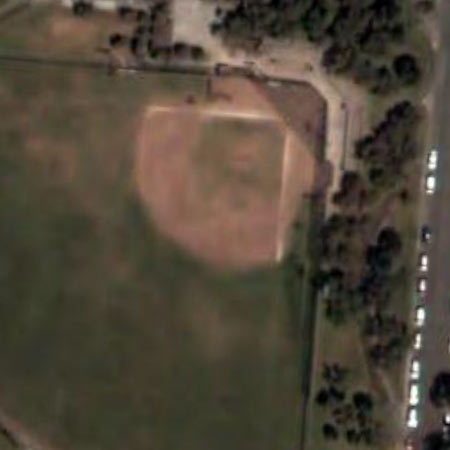
Doesn't look like much, but this crater is actually only 30 meters across! That's tiny! For comparison, the Bad Astronomer posts this picture he found on Google maps of something similar sized on Earth so we can get some idea of comparison:


Keep in mind, this image was taken of Mars. On Mars' closest approach a few years back, I had the opportunity to observe it with a 16" telescope (that's pretty damn big for those of you that aren't familiar with astronomical instruments). Even then, it was only about the size of a quarter held at arm's length. I was impressed that I could easily make out the polar caps as well as seveal light and dark features. But those features are all thousands of km in size. And here we are being able to resolve objects down to only a few meters across.

Simply amazing.

That's all for tonight, but I'm going to continue along this line and over the next few day, post about all the exciting things that are going on at several other places in the solar system including, Venus, the moon, Saturn, and probably more.