
In America, we frequently hear that this country "is a Christian Nation". While I disagree in some senses, this is in many ways very true; The majority of the nation is composed of Christians, and despite laws against it, Christian morality works its ways into our politics, schools, and just about everything else. Those of us that aren't Christians, or are but are the wrong kind of Christians constantly have an uphill battle to make sure that our rights aren't trodden upon. It would be wonderful for atheists as a minority, if we got the theocrats out of power and had a secular government.
So wouldn't it be strange for Christians to be the persecuted minority praying for a secular government?
Turns out, it's happening in India. The plight there seems worse than minorities have in the US, but it's a good reminder of what happens to minorities under sectarian governments. So while Christians have it good here, they should keep in mind just what it would be like if that shoe was on the other foot.
Sadly, experience has told me that those that most desperately need to keep this perspective are completely blind to it.
Tuesday, May 05, 2009

Monday, May 04, 2009
Pareidolia: n + 18
Apparently fried junk food must be among the favorite foods for divine beings. Of all the pareidolia cases I see, it seems there's an unusually large number from diners. Either that, or people working at such places are credulous twits. And yet again, a fuzzy figure has shown up on a griddle.
Sunday, May 03, 2009
Wednesday, April 29, 2009
NCLB Shown to be Ineffective... again.
The newest Nation's Report Card is out for the Math and Reading topics. Although gains have been made in both areas, they are strongest for the nine year old level. By the time you've reached the high school level, gains have been pretty marginal since the 1970's.
But don't let that from people saying it's effective. The education secretary, Margaret Spellings is quoted in the NY Times as saying,
One other interesting thing I found in the Report Card is that although the gender gap in math and science is usually reported to be large, the report card shows it to be small, at least in terms of math. Although it grows by the high school level (but only to 6 points out of 500 in the most recent year), it suggests that females aren't going into science and technology fields due to a lack of preparation or ability. Rather, the lack of females in these fields is more due to cultural stigmata drawing females into other lines of work. Something for teachers to keep in mind.
But don't let that from people saying it's effective. The education secretary, Margaret Spellings is quoted in the NY Times as saying,
It’s not an accident that we’re seeing the most improvement where N.C.L.B. has focused most vigorously.... The law focuses on math and reading in grades three through eight — it’s not about high schools. So these results are affirming of our accountability-type approach.Wonderful. We give kids a boost early on, but still allow our education to drop the ball by the time they complete high school. That's great!
One other interesting thing I found in the Report Card is that although the gender gap in math and science is usually reported to be large, the report card shows it to be small, at least in terms of math. Although it grows by the high school level (but only to 6 points out of 500 in the most recent year), it suggests that females aren't going into science and technology fields due to a lack of preparation or ability. Rather, the lack of females in these fields is more due to cultural stigmata drawing females into other lines of work. Something for teachers to keep in mind.
Monday, April 20, 2009
Things that don't work
I was going through my folder of links on things to write about, and found this article from the summer of last year that made me chuckle at just how wrong it turned out to be. Out in Iowa a bunch of people from the "Invincible America Assembly" got together to meditate and solve all of Americas problems. They predicted that they would send the stock market soaring via "harmonious waves" with the Dow surpassing 17,000.
HAHAHAHAHA! Nice timing. Predicting your voodoo would fix make a utopia right before the economy went in the shitter.
FAIL.
But to make the guy sound even dumber, consider this quote:
Sorry pal. Science works.
HAHAHAHAHA! Nice timing. Predicting your voodoo would fix make a utopia right before the economy went in the shitter.
FAIL.
But to make the guy sound even dumber, consider this quote:
We have control over things we didn't have control over before. That's the progress of scienceWha? He claims to be using science?!
Sorry pal. Science works.
Jedi Cops
News stories pop up from time to time about the "Jedi" religion over in the UK. But this story mentions there's a number of them that are police officers in Scotland!
I just giggle at it, but one comment stands out to me:
But whatever. Just as long as the cops are Jedi and not stormtroopers.
I just giggle at it, but one comment stands out to me:
As long as they don't try to start using ' the force' to try to solve crimes, I'm sure it's harmless.I doubt they'd be that silly. But then again...
But whatever. Just as long as the cops are Jedi and not stormtroopers.
Thursday, April 09, 2009
Not Just the Christians
In the three years I've been running this blog, I've seen an alarming numbers of botched exorcisms from Christians. I've never suspected that this was the only religious organization partaking in such archaic superstitions, but only that it popped up more in the media due to the fact that the media I observe is American, which is, by and large, Christian.
And I was right. A Buddhist man critically injured his son trying to expel demons from a statue he bought.
And I was right. A Buddhist man critically injured his son trying to expel demons from a statue he bought.
Friday, April 03, 2009
The problem with labs
Looking back on my time spent in college and recalling some of the best and most interesting times I had, there are several instances that stand out. Surprisingly, to some, most of them were the labs and research I worked in. Whether it was the tedious photometry of 1,500 stars in a cluster during my internship, or the laborious pouring over journals and trying to come up with a future research plan for my flare star research or even the advanced physics labs in which we spent far too much time for far too little credit demonstrating principles we had long since taken for granted, that final result of getting an answer and knowing that it was meaningful was a wonderful feeling of success.
So what is it we teach in high school labs?
Thinking back to the labs I did in high school, I can only remember about three labs. One was rolling blocky cars down inclined planes and trying to measure the force of gravity. One involved some pulleys and who knows what the point of that was. The last was spinning electrons in a magnetic field in some manner that caused them to scintilate and the diameter of the circle could be measured to determine the mass of the electron.
I always liked labs at that point, but in reflection, it was for a very different reason. It was a free day or two to not have to think. All we had to do was blindly measure what we were told, plug it into the equation we were given, and pop out numbers that were off from the values we should have been getting by, quite often, nearly an order of magnitude.
I can't be certain that my high school experience is completely indicative of the situation in the majority of schools (although Time magazine did choose my high school as representative of American high schools in 1999 when they did an expose on what life in high school is really like since Columbine), but assuming such conditions are common, I see two major problems with this.
The first is that such labs don't hold the students accountable for why they do anything they do in such labs. There is little connection between what is taught in the lecture portion, and how the lab was created to illustrate or test the concept in question. Pick up any journal article and there is always a lengthy section right at the beginning setting up the theoretical framework before any description of methodology in an experiment is even approached. Yet this has always been absent from my memory of high school labs as well as the introductory astronomy labs I taught during my time at KU. While I was able to insert this material in my own labs via my lectures prior to the start of lab, this, as best my memory serves, was completely absent from any labs in lower levels.
The other thing that is similarly neglected in high school labs is something that actually stands out like a sore thumb: The amount of error. Error in measurements is, of course, unavoidable. Whether its due to inherent limitations in tools, or variables that cannot be constrained at such levels (eg. how do you try to approach friction and drag in carts when the math needed to do so is at least two years of college beyond what most high school students will ever obtain), the order of magnitude errors I discussed earlier are often just swept under the rug.
So what does this tell students? The message is that science is sloppy. Measurements can be wildly different and it's ok.
What's not included, but I feel should be, is at the very least, some sort of quantitative analysis of the error involved. In my own classroom, I've seen this attempted, and the way I've always seen it done for low level classes is wholly disappointing. In most low level classrooms, the method to determine error is that you take the difference between the "True" value and your value, and divide it by the "True" value. This gives the amount that you're off.
But since when does real science have a "True" value by which to compare the derived value?
Never. And we wonder why people nod in agreement when creationists push the notion that science is dogmatic when we're the ones putting ideas of "True" values in their head?
This methodology seems entirely counterproductive. While equations to determine error are obviously beyond the capabilities of high school students, I feel there is still a solution.
Although the capability to carry out higher mathematics is certainly constrained to such students, what I do not feel is limited is the ability to show the qualitative reasoning behind the math. Even the concepts of calculus aren't beyond the capabilities of students.
To give an example: In the lab I taught at KU, we had an assignment in which students were required to measure the position the sun set along the horizon throughout the semester (ie, the azimuthal angle). One of the questions we required students to address was "When was the rate of change the fastest?"
To those that have taken a calculus course, the answer is instantly obvious: the highest rate of change is the point on the graph with the steepest slope.
While, as an instructor, I can point this out to students and they'll swallow it, the point becomes even more convincing when a bit of dimensional analysis is performed and I demonstrate that the slope of the graph does indeed give the correct units for the rate of change!
Similarly, I feel that, even if an important equation is, in a quantitative sense, too difficult for a student, we should at least approach it qualitatively, and then do the quantitative bits for them. In other words, the instructor should solve the equation for the given lab so that students (once they understand what the equation is doing) may simply plug in the necessary numbers.
This alleviates the problem I have presented; Instead of telling students that there is error and doing vague hand waving claiming it's "friction" or other ways of sidestepping it, it lets students know that, in real science, not only do we consider the error in our techniques, we can even say how much!
There is, of course, another, probably simpler solution: Get rid of labs with such high inherent errors. Instead, find labs that can be easily constructed with minimal tools that still result in high accuracy measurements.
My favorite lab I've seen along this line is one involving measuring the speed of light with nothing more than a bag of chocolate chips, a microwave and a ruler. I've done the experiment myself and even gone through complete error analysis. The result I got for it had less than a 1% error and fell, within significant digits and the error bars, right on top of the canonical values of the speed of light!
Now why didn't I ever do this in high school?
So what is it we teach in high school labs?
Thinking back to the labs I did in high school, I can only remember about three labs. One was rolling blocky cars down inclined planes and trying to measure the force of gravity. One involved some pulleys and who knows what the point of that was. The last was spinning electrons in a magnetic field in some manner that caused them to scintilate and the diameter of the circle could be measured to determine the mass of the electron.
I always liked labs at that point, but in reflection, it was for a very different reason. It was a free day or two to not have to think. All we had to do was blindly measure what we were told, plug it into the equation we were given, and pop out numbers that were off from the values we should have been getting by, quite often, nearly an order of magnitude.
I can't be certain that my high school experience is completely indicative of the situation in the majority of schools (although Time magazine did choose my high school as representative of American high schools in 1999 when they did an expose on what life in high school is really like since Columbine), but assuming such conditions are common, I see two major problems with this.
The first is that such labs don't hold the students accountable for why they do anything they do in such labs. There is little connection between what is taught in the lecture portion, and how the lab was created to illustrate or test the concept in question. Pick up any journal article and there is always a lengthy section right at the beginning setting up the theoretical framework before any description of methodology in an experiment is even approached. Yet this has always been absent from my memory of high school labs as well as the introductory astronomy labs I taught during my time at KU. While I was able to insert this material in my own labs via my lectures prior to the start of lab, this, as best my memory serves, was completely absent from any labs in lower levels.
The other thing that is similarly neglected in high school labs is something that actually stands out like a sore thumb: The amount of error. Error in measurements is, of course, unavoidable. Whether its due to inherent limitations in tools, or variables that cannot be constrained at such levels (eg. how do you try to approach friction and drag in carts when the math needed to do so is at least two years of college beyond what most high school students will ever obtain), the order of magnitude errors I discussed earlier are often just swept under the rug.
So what does this tell students? The message is that science is sloppy. Measurements can be wildly different and it's ok.
What's not included, but I feel should be, is at the very least, some sort of quantitative analysis of the error involved. In my own classroom, I've seen this attempted, and the way I've always seen it done for low level classes is wholly disappointing. In most low level classrooms, the method to determine error is that you take the difference between the "True" value and your value, and divide it by the "True" value. This gives the amount that you're off.
But since when does real science have a "True" value by which to compare the derived value?
Never. And we wonder why people nod in agreement when creationists push the notion that science is dogmatic when we're the ones putting ideas of "True" values in their head?
This methodology seems entirely counterproductive. While equations to determine error are obviously beyond the capabilities of high school students, I feel there is still a solution.
Although the capability to carry out higher mathematics is certainly constrained to such students, what I do not feel is limited is the ability to show the qualitative reasoning behind the math. Even the concepts of calculus aren't beyond the capabilities of students.
To give an example: In the lab I taught at KU, we had an assignment in which students were required to measure the position the sun set along the horizon throughout the semester (ie, the azimuthal angle). One of the questions we required students to address was "When was the rate of change the fastest?"
To those that have taken a calculus course, the answer is instantly obvious: the highest rate of change is the point on the graph with the steepest slope.
While, as an instructor, I can point this out to students and they'll swallow it, the point becomes even more convincing when a bit of dimensional analysis is performed and I demonstrate that the slope of the graph does indeed give the correct units for the rate of change!
Similarly, I feel that, even if an important equation is, in a quantitative sense, too difficult for a student, we should at least approach it qualitatively, and then do the quantitative bits for them. In other words, the instructor should solve the equation for the given lab so that students (once they understand what the equation is doing) may simply plug in the necessary numbers.
This alleviates the problem I have presented; Instead of telling students that there is error and doing vague hand waving claiming it's "friction" or other ways of sidestepping it, it lets students know that, in real science, not only do we consider the error in our techniques, we can even say how much!
There is, of course, another, probably simpler solution: Get rid of labs with such high inherent errors. Instead, find labs that can be easily constructed with minimal tools that still result in high accuracy measurements.
My favorite lab I've seen along this line is one involving measuring the speed of light with nothing more than a bag of chocolate chips, a microwave and a ruler. I've done the experiment myself and even gone through complete error analysis. The result I got for it had less than a 1% error and fell, within significant digits and the error bars, right on top of the canonical values of the speed of light!
Now why didn't I ever do this in high school?
Thursday, April 02, 2009
Life - Or something like it
Bah. Almost 4 months since I've posted anything here. Certainly a new record.
As I pointed out back in November, my life has largely taken me away from the topics about which this blog is ostensibly centered.
However, as things often go, life is beginning to take me back to topics on which I feel are worthwhile to blog about.
I've mentioned my attendance at conventions several times in the past, and this past month saw yet another con come and go. This one was Naka Kon 2009 and was my first con I've attended as a staff member (game room overlord if anyone cares). Aside from that duty, I also managed to get myself roped into MCing the cosplay competition (Note to self: Next year, wear gel insoles in costume's shoes).
But perhaps most pertinent was the panel I prepared. It's something I'd been working on for nearly 5 months and went over astoundingly well. The title was "Science of Anime". The idea was to take various phenomenon I'd noticed in anime that were certainly not realistically possible, and use science to show just how nonsensical they really were. The title was patterned off the series of TV shows with titles like "Science of Star Wars" or the "Science of Batman" which occasionally pop up on the Discovery channel. In reflection, I really wish I hadn't named it such (and I'll probably change it in the future) because those shows try to rationalize obviously fictional events with scientific principles but stretch them so implausibly all over, that it's right back into the realm of science fiction. The shows are cute, but ultimately I'm not a fan of them. Thus, I think my future title will be "Anime Mythbusters - Where everything's BUSTED".
Anyway, the panel was videotaped, but since it was in a dark room with a powerpoint, the room is too dark to see me, and the screen is to bright and is overexposed. So the video is worthless. I'm working on getting the audio ripped and making a video with just the slides, but it'll take awhile longer since the person doing my editing work's computer doesn't like the codecs I used to export some of the videos. I'll make a post when it's up on Youtube (or perhaps somewhere else).
Life is also working to take me towards a new career. For the past 9 months, I've been working as a waiter to pay the bills until my lease is up and I can look for a real job somewhere else, but now I'm planning on moving back to St Louis and am planning to teach high school physics (and astronomy if the school offers a course in that area). As such, physics and astronomy education have been on my mind quite a bit recently and I have ideas for a few posts on that topic that I'll likely be writing up when I find time. I've already done an interview with one school district and have resumes out to a few more. Hopefully things will go well.
As I pointed out back in November, my life has largely taken me away from the topics about which this blog is ostensibly centered.
However, as things often go, life is beginning to take me back to topics on which I feel are worthwhile to blog about.
I've mentioned my attendance at conventions several times in the past, and this past month saw yet another con come and go. This one was Naka Kon 2009 and was my first con I've attended as a staff member (game room overlord if anyone cares). Aside from that duty, I also managed to get myself roped into MCing the cosplay competition (Note to self: Next year, wear gel insoles in costume's shoes).
But perhaps most pertinent was the panel I prepared. It's something I'd been working on for nearly 5 months and went over astoundingly well. The title was "Science of Anime". The idea was to take various phenomenon I'd noticed in anime that were certainly not realistically possible, and use science to show just how nonsensical they really were. The title was patterned off the series of TV shows with titles like "Science of Star Wars" or the "Science of Batman" which occasionally pop up on the Discovery channel. In reflection, I really wish I hadn't named it such (and I'll probably change it in the future) because those shows try to rationalize obviously fictional events with scientific principles but stretch them so implausibly all over, that it's right back into the realm of science fiction. The shows are cute, but ultimately I'm not a fan of them. Thus, I think my future title will be "Anime Mythbusters - Where everything's BUSTED".
Anyway, the panel was videotaped, but since it was in a dark room with a powerpoint, the room is too dark to see me, and the screen is to bright and is overexposed. So the video is worthless. I'm working on getting the audio ripped and making a video with just the slides, but it'll take awhile longer since the person doing my editing work's computer doesn't like the codecs I used to export some of the videos. I'll make a post when it's up on Youtube (or perhaps somewhere else).
Life is also working to take me towards a new career. For the past 9 months, I've been working as a waiter to pay the bills until my lease is up and I can look for a real job somewhere else, but now I'm planning on moving back to St Louis and am planning to teach high school physics (and astronomy if the school offers a course in that area). As such, physics and astronomy education have been on my mind quite a bit recently and I have ideas for a few posts on that topic that I'll likely be writing up when I find time. I've already done an interview with one school district and have resumes out to a few more. Hopefully things will go well.
Friday, December 12, 2008
A page from the "Well no shit" files
I hear all the time that religion doesn't make people mistrustful of science all the time. It just happens that there's a direct correlation between religious belief and the ignorant criticism of evolution. It's not all science. Just that one area.
Oh yeah. And nanotechnology.
The article also said that mistrust of "the internet, genetically modified food, nuclear power" and other things tended to go along with distrust in nanotechnology.
In other words, religion gives people a general sense of paranoia in which everything's turned into another demon from which they need saving. Forget that pesky reality.
"The researchers say their finding support the idea that underlying cultural beliefs have a stronger influence on opinions formed about nanotechnology than science based information".
Duh.
Oh yeah. And nanotechnology.
The article also said that mistrust of "the internet, genetically modified food, nuclear power" and other things tended to go along with distrust in nanotechnology.
In other words, religion gives people a general sense of paranoia in which everything's turned into another demon from which they need saving. Forget that pesky reality.
"The researchers say their finding support the idea that underlying cultural beliefs have a stronger influence on opinions formed about nanotechnology than science based information".
Duh.
Thursday, December 04, 2008
Another Child Murdered thanks to Exocism
Q: How do you get demons out of a 1 year old?
A: With a hammer.
And how does such religious nonsense not promote child abuse again?
A: With a hammer.
And how does such religious nonsense not promote child abuse again?
Tuesday, December 02, 2008
Pareidolia: n + 17
Jesus is a rock fan? Who'd have guessed that he'd show up on a guitar.
Not really sure it looks like Jesus. That beard is pretty ratty. Or perhaps it's just tentacles and PZ needs to learn how to play.
But if it is Jesus, does he like Pearl Jam or the Stones?
Not really sure it looks like Jesus. That beard is pretty ratty. Or perhaps it's just tentacles and PZ needs to learn how to play.
But if it is Jesus, does he like Pearl Jam or the Stones?
Thursday, November 27, 2008
Myth: Confirmed
 The most recent XKCD proposes an interesting astrophysical scenario. It deals with something I've mentioned a few times on this blog before: Solar flares. If you haven't seen it, here's the comic: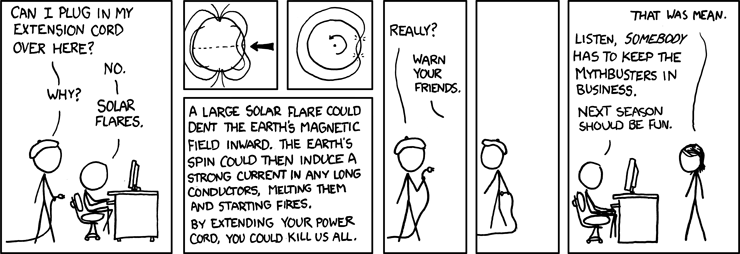
HAHAHAHAHAHA!
Yeah right. A solar flare indenting the magnetic field to such an extent that the Earth's rotation causes an induced current in electrical cords.
No way that could happen.
Except that it did.
In 1859, a solar flare so powerful occurred that it shorted out telegraph wires causing fires on the desks of the operators in the US and Europe. In addition, it reduced the amount of atmospheric ozone by about 5% (Note to global warming deniers: This would only be a short term effect and human made ozone depletion is long term since CFCs don't readily leave the atmosphere).
So, amazingly this myth was confirmed nearly 150 years ago! So can I have Kari Byron do a guest post now?
B. C. Thomas, C. H. Jackman, A. L. Melott (2007). Modeling atmospheric effects of the September 1859 solar flare Geophysical Research Letters, 34 (6) DOI: 10.1029/2006GL029174
Thursday, November 20, 2008
I'm not sure I like this idea
New Scientist has an article up describing an attempt to meld science and Hollywood. Initially I liked the idea. How could I really be against getting better science into mainstream media?!
And then I remembered: The majority of science is mundane, boring, tedious number crunching. It's not exciting. It doesn't fit in Hollywood. It's like putting a round peg in a square hole. So what can be done to try to make the science exciting enough for Hollywood?
As I see it, there's two options:
1) Skip all the boring bits and get straight to the "Whiz Bang" bits and "Eureka" moments.
OR
2) Find things that aren't really tested anyway and are crazy fringe science.
My problem with this is that either way, it's still misportraying science. The article gives a perfect example:
While I see Hollywood's reasoning for doing it (it draws in the geeks), I also see the problem: It continues to confuse the picture of what science really is. We already have folks like the Discovery Institute hard at work doing that.
So while I appreciate the attempt from MacFarlane and Hollywood to put a bit more scientific rigor into their work, I just don't think it will work out too well for the simple reason that the two have very different intentions: One seeks to entertain, the other seeks to discover.
Meanwhile, I do like what the Zuckers said in the article about how science saved their daughter's life:
And then I remembered: The majority of science is mundane, boring, tedious number crunching. It's not exciting. It doesn't fit in Hollywood. It's like putting a round peg in a square hole. So what can be done to try to make the science exciting enough for Hollywood?
As I see it, there's two options:
1) Skip all the boring bits and get straight to the "Whiz Bang" bits and "Eureka" moments.
OR
2) Find things that aren't really tested anyway and are crazy fringe science.
My problem with this is that either way, it's still misportraying science. The article gives a perfect example:
[MacFarlane] just finished making a Family Guy episode based on the possibility that there are multiple universes, prompted by a documentary he saw on the subject.What's wrong with this? Where's the good science in multiple universe hypotheses? Where's the testing? Sure multiple universes sound good and sciencey, but when you get right down to it, it's not. It's a possible branch of science that's still in its infancy. It is a nice construct to start working from, and then develop ways to test it as we go, but chances are, like so many other things, it's quite likely that if/when we ever do test it, it will turn out to be bogus. And do we really want to be showing the public more bits of tenuous science that in all honesty, are pretty hollow?
"I didn't really know that that was a real thing, that it was possible [and] being theorised about," he said. "So we did a story about it."
While I see Hollywood's reasoning for doing it (it draws in the geeks), I also see the problem: It continues to confuse the picture of what science really is. We already have folks like the Discovery Institute hard at work doing that.
So while I appreciate the attempt from MacFarlane and Hollywood to put a bit more scientific rigor into their work, I just don't think it will work out too well for the simple reason that the two have very different intentions: One seeks to entertain, the other seeks to discover.
Meanwhile, I do like what the Zuckers said in the article about how science saved their daughter's life:
"They gave here a shot of insulin and this was like a miracle, because she was laying there on the examining table, and within a few hours she came alive again, her lustre came back," Janet Zucker said.That's right. Science.Saves.Lives.
Religulous Review
Religulous has been out for a good while now, but I finally got around to seeing it last night. My overall impression of the movie wasn't overly impressed.
That being said, I think a good subtitle for this movie would be "Bill Maher preaches to the choir."
The large majority of this movie is going around to various religious people and showing that they (a) believe in things that are completely nuts like the virgin birth, or (b) are stunningly ignorant about their own religious history.
The reason that I say Billy is preaching to the choir is that it isn't likely that anyone that is religious sees anything wrong with this. They either see bogus miracles as truly miraculous, or are equally ignorant. As such, anyone that doesn't already agree with what Bill is saying probably won't get it.
And Maher doesn't even seem to care. Instead of trying to explain just why these people are ignorant, and trying to actually teach the audience something about what he's talking about, he just tosses things out there with no explanation. A perfect example is when Bill is talking to a Muslim about the view of many Muslims that anyone who challenges their religion should be killed. The Muslim says this isn't true and that it allows for discussion. Maher brings up the case of Salman Rushdie, and asks whether or not he deserves to be killed. The Muslim tries to waffle his way out and gives a non-answer worthy of the Discovery Institute.
I know who Salman Rushdie is. Maher knows who Salman Rushdie is. The Muslim Bill is talking to knows who Salman Rushdie is. But does the audience? Not exactly likely. I only know because SOMA brought him to KU a few years back. But Maher doesn't even try to take a bit of time to explain the situation. If you already know, then it makes sense. If you're not part of the choir, well, that part's probably lost on you.
Maher also seemed to use quite a few silly tricks when interviewing people. He'd ask a serious question and inevitably, the religious person would have to stop because they couldn't answer it. Of course, the way the editing was done, it makes me genuinely curious as to how many of the dazed pauses were legitimate and how many were edited in. I'd like to give the benefit of the doubt here, but some just looked staged.
Another trick Maher used to force people to slip up was to ask a legitimate question and then, when they tried to answer it, make a joke out of it. The natural response to this is to stop and wonder, "How do I respond to this? As a serious question, or to the joke?" Those forced pauses I'm sure were abused as well.
Maher also tended to go after some people with pathetically weak education and theology. Showing up to a trucker's church? Yeah. Insightful theology there Billy.
There were some highlights of Bill meeting with some better religious authorities. As usual, former head of the Vatican Observatory, Geroge Coyne impressed me with his honest and informed answers. Francis Collins, head of the Human Genome Project, was better than most but still made himself look like a twit without Maher even having to try. But perhaps my favorite person Maher talked to was a Catholic priest just after Maher got kicked out of the Vatican. This guy admitted that most of the religion was full of hot air and was extremely laid back about the whole deal. Why can't we get priests like him in the US?!
So overall, the show had its high points and low points. It was 90% Bill showing that religious people are, by and large, at least compartmentally stupid. But as I said before, to those that would see this as such are people that would already agree. Those that can't see this are the ones being made fun of.
But what about that other 10%?
This last little bit was what I think the real highlight of the movie was. It was mentioned right at the beginning, and then was the main point at the end. One quote summed it up pretty well. I know this isn't quite right, but the notion is, "It's a shame that humanity developed the ability to destroy the world before it developed the ability to be rational."
This is the point that I agree with wholeheartedly. For the first time in human history, we have the ability to destroy our entire species. With this horrible threat, we can no longer practice the naive rituals of non-thought, however comforting they may be.
I really wish this theme would have been worked far more throughout the film, and stronger connections drawn with the lack of critical thinking and the consequences its already wrought. Instead, Maher left the cause and the effect only connected with a tenuous slippery slope. I think the message is solid, but this movie did not do a good job of showing it. The only thing it did do, was provide a bit of schadenfreude for those of us that already get it.
That being said, I think a good subtitle for this movie would be "Bill Maher preaches to the choir."
The large majority of this movie is going around to various religious people and showing that they (a) believe in things that are completely nuts like the virgin birth, or (b) are stunningly ignorant about their own religious history.
The reason that I say Billy is preaching to the choir is that it isn't likely that anyone that is religious sees anything wrong with this. They either see bogus miracles as truly miraculous, or are equally ignorant. As such, anyone that doesn't already agree with what Bill is saying probably won't get it.
And Maher doesn't even seem to care. Instead of trying to explain just why these people are ignorant, and trying to actually teach the audience something about what he's talking about, he just tosses things out there with no explanation. A perfect example is when Bill is talking to a Muslim about the view of many Muslims that anyone who challenges their religion should be killed. The Muslim says this isn't true and that it allows for discussion. Maher brings up the case of Salman Rushdie, and asks whether or not he deserves to be killed. The Muslim tries to waffle his way out and gives a non-answer worthy of the Discovery Institute.
I know who Salman Rushdie is. Maher knows who Salman Rushdie is. The Muslim Bill is talking to knows who Salman Rushdie is. But does the audience? Not exactly likely. I only know because SOMA brought him to KU a few years back. But Maher doesn't even try to take a bit of time to explain the situation. If you already know, then it makes sense. If you're not part of the choir, well, that part's probably lost on you.
Maher also seemed to use quite a few silly tricks when interviewing people. He'd ask a serious question and inevitably, the religious person would have to stop because they couldn't answer it. Of course, the way the editing was done, it makes me genuinely curious as to how many of the dazed pauses were legitimate and how many were edited in. I'd like to give the benefit of the doubt here, but some just looked staged.
Another trick Maher used to force people to slip up was to ask a legitimate question and then, when they tried to answer it, make a joke out of it. The natural response to this is to stop and wonder, "How do I respond to this? As a serious question, or to the joke?" Those forced pauses I'm sure were abused as well.
Maher also tended to go after some people with pathetically weak education and theology. Showing up to a trucker's church? Yeah. Insightful theology there Billy.
There were some highlights of Bill meeting with some better religious authorities. As usual, former head of the Vatican Observatory, Geroge Coyne impressed me with his honest and informed answers. Francis Collins, head of the Human Genome Project, was better than most but still made himself look like a twit without Maher even having to try. But perhaps my favorite person Maher talked to was a Catholic priest just after Maher got kicked out of the Vatican. This guy admitted that most of the religion was full of hot air and was extremely laid back about the whole deal. Why can't we get priests like him in the US?!
So overall, the show had its high points and low points. It was 90% Bill showing that religious people are, by and large, at least compartmentally stupid. But as I said before, to those that would see this as such are people that would already agree. Those that can't see this are the ones being made fun of.
But what about that other 10%?
This last little bit was what I think the real highlight of the movie was. It was mentioned right at the beginning, and then was the main point at the end. One quote summed it up pretty well. I know this isn't quite right, but the notion is, "It's a shame that humanity developed the ability to destroy the world before it developed the ability to be rational."
This is the point that I agree with wholeheartedly. For the first time in human history, we have the ability to destroy our entire species. With this horrible threat, we can no longer practice the naive rituals of non-thought, however comforting they may be.
I really wish this theme would have been worked far more throughout the film, and stronger connections drawn with the lack of critical thinking and the consequences its already wrought. Instead, Maher left the cause and the effect only connected with a tenuous slippery slope. I think the message is solid, but this movie did not do a good job of showing it. The only thing it did do, was provide a bit of schadenfreude for those of us that already get it.
Tuesday, November 18, 2008
*Headdesk*
Sometimes, after I really haven't dealt with any Creationists in a good while, I start to forget just how intellectually bankrupt they are. I start to think that, maybe they really do care about things like evidence and that they're just confused about it or blissfully ignorant.
Or maybe they do want to use the scientific method, but just can't quite remember what it was because junior high was really just that long ago and they're much too busy studying the Bible to have time to brush up on even the basics of that which they criticize.
Or just maybe they try not to use logical fallacies, but can't quite get a grasp on what things like circular logic, equivocation, strawmen, and the like are.
And then I see a bumper sticker like this one.

And suddenly I remember; Creationists don't care about evidence; Creationists don't care about science; Creationists don't care about logic. They're just that dense.
My mistake for trying to give them the benefit of the doubt.
Thanks to oncolgist in the livejournal atheism group for the image.
Or maybe they do want to use the scientific method, but just can't quite remember what it was because junior high was really just that long ago and they're much too busy studying the Bible to have time to brush up on even the basics of that which they criticize.
Or just maybe they try not to use logical fallacies, but can't quite get a grasp on what things like circular logic, equivocation, strawmen, and the like are.
And then I see a bumper sticker like this one.

And suddenly I remember; Creationists don't care about evidence; Creationists don't care about science; Creationists don't care about logic. They're just that dense.
My mistake for trying to give them the benefit of the doubt.
Thanks to oncolgist in the livejournal atheism group for the image.
Pareidolia: n + 16
Back from Nebraskon (will have a post on that later)! And while cleaning out my links folder today, I ran across this link I stumbled across awhile ago and never got around to posting!
Yep. It's more Jesus. And this time he's in a water stain on the ceiling in a weight loss center. He shows up because he loves you.... And he wants you to be thin.... And he needs your money...
Yep. It's more Jesus. And this time he's in a water stain on the ceiling in a weight loss center. He shows up because he loves you.... And he wants you to be thin.... And he needs your money...
Tuesday, November 11, 2008
What else has been going on
Last week I said one of the reasons I haven't been posting much is that there just hasn't been much going on besides politics and we're all sick to death of that. Another reason is that, now that I've graduated, I've been able to devote more time to other hobbies that aren't things I typically post about on this blog. I don't intend to make them a major portion of my blog, but it's worth mentioning.
In particular, I've gone and gotten myself a Netflix account. I've seen a few films I just missed in theaters that I wanted to catch (like the Simpsons movie), a few that are classics I've wanted to see for a long time (Seven Samurai) and quite a bit of anime (Full Metal Alchemist, Hellsing and Cowboy Bebop). Most of my evenings are spent, at least in part watching something from Netflix.
I've also been playing a lot of World of Warcraft. With the new expansion coming out this week, it's been more fun because many of the players that disappeared over the summer in my guild are coming back, so raids have been much more frequent and well attended.
 For those that are interested, I have three characters I play regularly. All are on the Stormreaver. My main is Tiadara. She's my badass shadow priest. She enjoys short runs through Karazhan and playing mana battery for 24 other guys. Hot.
My second 70 is Ellobrosa. I don't tend to play him much anymore since Huntards are a dime a dozen so his main purpose is to help use his Track Humanoids skill to find those annoying Horde that just ganked my lowbies or guild mates.
Sebiole is my third character I play regularly. I got tired of not being able to find a tank so I'm leveling her prot spec. Not a terribly good idea. Sure, I have tons of health and don't die easily, but damn does it take forever for me to kill stuff.
So that's the digital persons I hide behind most nights I'm not out being social.
Aside from WoW, I've also been able to take more time to head to conventions. And by conventions, I mean convention. Sadly, there's very few in the midwest worth visiting. I did manage to make it to Archon 32 last month. It was pretty lame aside from the costume contest, but since costuming is what I go for anyway, I didn't mind. My gallery of pictures of the costumes is here.
I'll be at Nebraskon this coming weekend. It's looking like I'll be there as one of the official representatives of Naka Kon which is the Kansas City anime convention originally started by KU's anime club. I've been made a staff member of that so show up if you're in the area! I'll be running a panel entitled "The Science of Anime" which will attempt to answer questions like, "If someone were really falling the amount of time it took Naruto to shout that ridiculously long sentence, how far would he have fallen and how fast would he hit the ground?" It should be fun.
In particular, I've gone and gotten myself a Netflix account. I've seen a few films I just missed in theaters that I wanted to catch (like the Simpsons movie), a few that are classics I've wanted to see for a long time (Seven Samurai) and quite a bit of anime (Full Metal Alchemist, Hellsing and Cowboy Bebop). Most of my evenings are spent, at least in part watching something from Netflix.
I've also been playing a lot of World of Warcraft. With the new expansion coming out this week, it's been more fun because many of the players that disappeared over the summer in my guild are coming back, so raids have been much more frequent and well attended.
For those that are interested, I have three characters I play regularly. All are on the Stormreaver. My main is Tiadara. She's my badass shadow priest. She enjoys short runs through Karazhan and playing mana battery for 24 other guys. Hot.My second 70 is Ellobrosa. I don't tend to play him much anymore since Huntards are a dime a dozen so his main purpose is to help use his Track Humanoids skill to find those annoying Horde that just ganked my lowbies or guild mates.
Sebiole is my third character I play regularly. I got tired of not being able to find a tank so I'm leveling her prot spec. Not a terribly good idea. Sure, I have tons of health and don't die easily, but damn does it take forever for me to kill stuff.
So that's the digital persons I hide behind most nights I'm not out being social.
Aside from WoW, I've also been able to take more time to head to conventions. And by conventions, I mean convention. Sadly, there's very few in the midwest worth visiting. I did manage to make it to Archon 32 last month. It was pretty lame aside from the costume contest, but since costuming is what I go for anyway, I didn't mind. My gallery of pictures of the costumes is here.
I'll be at Nebraskon this coming weekend. It's looking like I'll be there as one of the official representatives of Naka Kon which is the Kansas City anime convention originally started by KU's anime club. I've been made a staff member of that so show up if you're in the area! I'll be running a panel entitled "The Science of Anime" which will attempt to answer questions like, "If someone were really falling the amount of time it took Naruto to shout that ridiculously long sentence, how far would he have fallen and how fast would he hit the ground?" It should be fun.
STEM & Women
Back when I was still attending MSU, I attended a regional meeting of of the Society of Physics Students (SPS). One of the topics was the number of females in STEM (Science, Technology, Engineering, and Mathematics) fields. The speaker challenged us to try to name famous women that had made notable contributions to our fields.
In astronomy, several names popped to mind: Margaret Geller. Annie Cannon. Maria Mitchell.
I listed those few I could come up with, but in the entire auditorium, I was the only student that could name a single one.
In a similar situation, while I was taking Calculus 2, my professor said that if the entire class could name three female mathematicians, he would cancel the final. All the students began flipping furiously through their textbooks for names, but only turned up one.
For anyone in the field, it's obvious that females are grossly underrepresented (astronomy seems to be one of the hottest scientific fields for women however), but the question has always been, "why?".
A recent paper from the AMS has taken a fresh look at this issue. What the paper describes is likely not surprising to most people; The most significant factors the researchers found was cultural views on such fields. In countries which do not afford women the same opportunities as males for mathematics education, women obviously are strongly underrepresented. However, when the ability is given to compete equally as with Title IX in the US, women become more frequent in the fields. Yet still not as represented.
Part of the reason, the researchers conclude, is that there remains some social taboo against such fields. Women from Asian and Indian countries are far more common in the STEM fields.
Another interesting note was that even in societies were math is seen as "geeky" and not an appropriate field for women, girls tend to do just as well as males in elementary schools. Only when social pressures start taking over in middle schools do girls start falling behind notably.
So how does the US stack up here? As you might expect with how poor I and other science bloggers have noted the US education system is in respect to science, it doesn't do too well:
In astronomy, several names popped to mind: Margaret Geller. Annie Cannon. Maria Mitchell.
I listed those few I could come up with, but in the entire auditorium, I was the only student that could name a single one.
In a similar situation, while I was taking Calculus 2, my professor said that if the entire class could name three female mathematicians, he would cancel the final. All the students began flipping furiously through their textbooks for names, but only turned up one.
For anyone in the field, it's obvious that females are grossly underrepresented (astronomy seems to be one of the hottest scientific fields for women however), but the question has always been, "why?".
A recent paper from the AMS has taken a fresh look at this issue. What the paper describes is likely not surprising to most people; The most significant factors the researchers found was cultural views on such fields. In countries which do not afford women the same opportunities as males for mathematics education, women obviously are strongly underrepresented. However, when the ability is given to compete equally as with Title IX in the US, women become more frequent in the fields. Yet still not as represented.
Part of the reason, the researchers conclude, is that there remains some social taboo against such fields. Women from Asian and Indian countries are far more common in the STEM fields.
Another interesting note was that even in societies were math is seen as "geeky" and not an appropriate field for women, girls tend to do just as well as males in elementary schools. Only when social pressures start taking over in middle schools do girls start falling behind notably.
So how does the US stack up here? As you might expect with how poor I and other science bloggers have noted the US education system is in respect to science, it doesn't do too well:
Asian girls and white girls who are immigrants from Eastern Europe are well represented among the very top students identified in the extremely difficult mathematics competitions discussed here; it is only USA-born white and historically underrepresented minority girls who are underrepresented, underrepresented by almost two orders-of magnitude relative to Asian girls educated in the same school systemsGo go cultural taboos America!
Wednesday, November 05, 2008
Finally! It's over!
No more political commercials, debates, rallies, and everything else!
If everyone's been wondering where I've been the past few months, I've been taking a break from blogging. The election stole the spotlight from everything else, so there really hasn't been much to write on. The creationists have been shoved out of the spotlight. Astronomy news doesn't come as frequently anymore since I'm not constantly reading journals after graduation. So there really hasn't been much to say. And if there is, that crazy bald guy seems to always beat me to it.
But now all the political nonsense is out of the way, I'll try to post a bit more frequently.
If everyone's been wondering where I've been the past few months, I've been taking a break from blogging. The election stole the spotlight from everything else, so there really hasn't been much to write on. The creationists have been shoved out of the spotlight. Astronomy news doesn't come as frequently anymore since I'm not constantly reading journals after graduation. So there really hasn't been much to say. And if there is, that crazy bald guy seems to always beat me to it.
But now all the political nonsense is out of the way, I'll try to post a bit more frequently.
Subscribe to:
Posts (Atom)
